
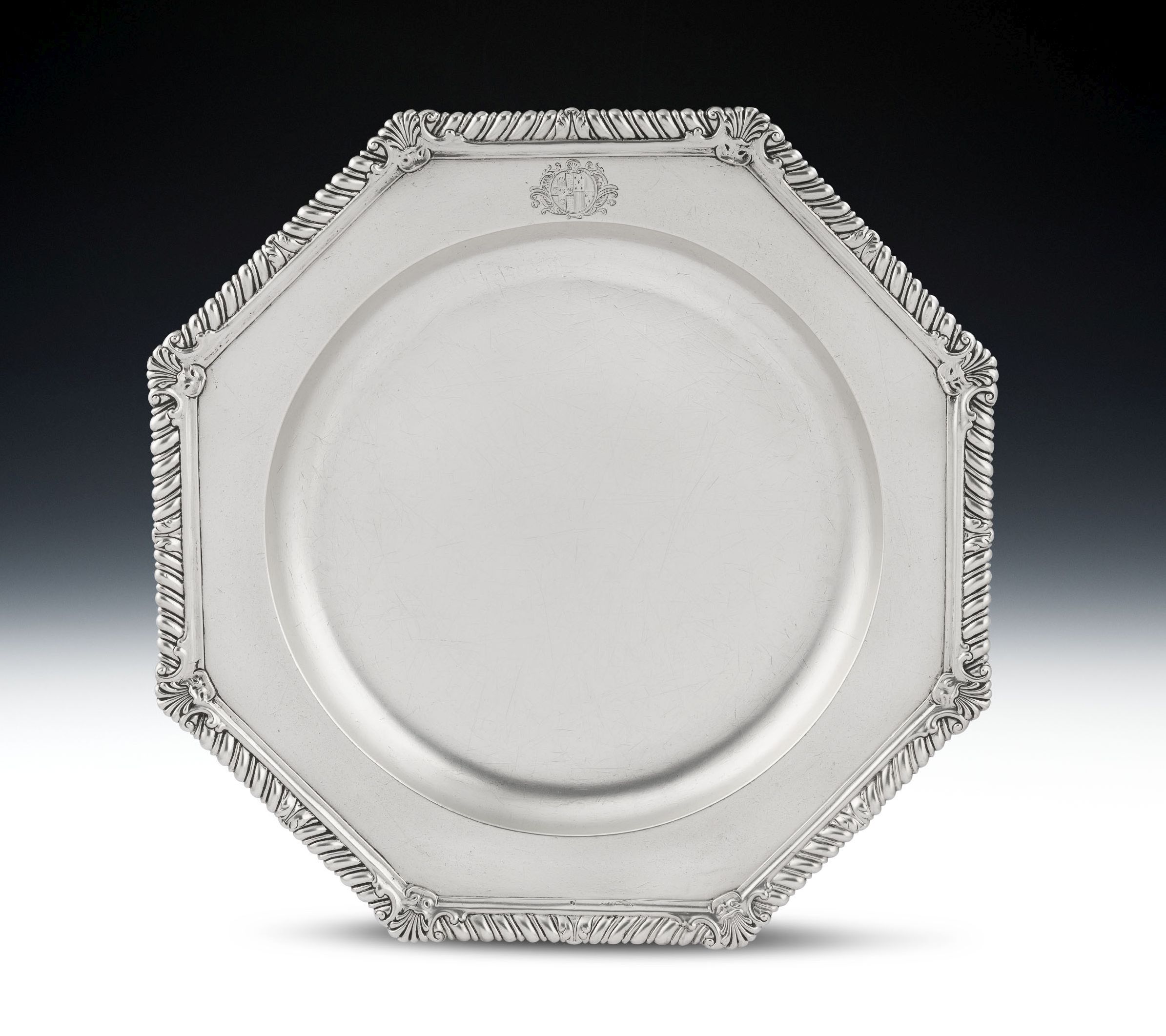
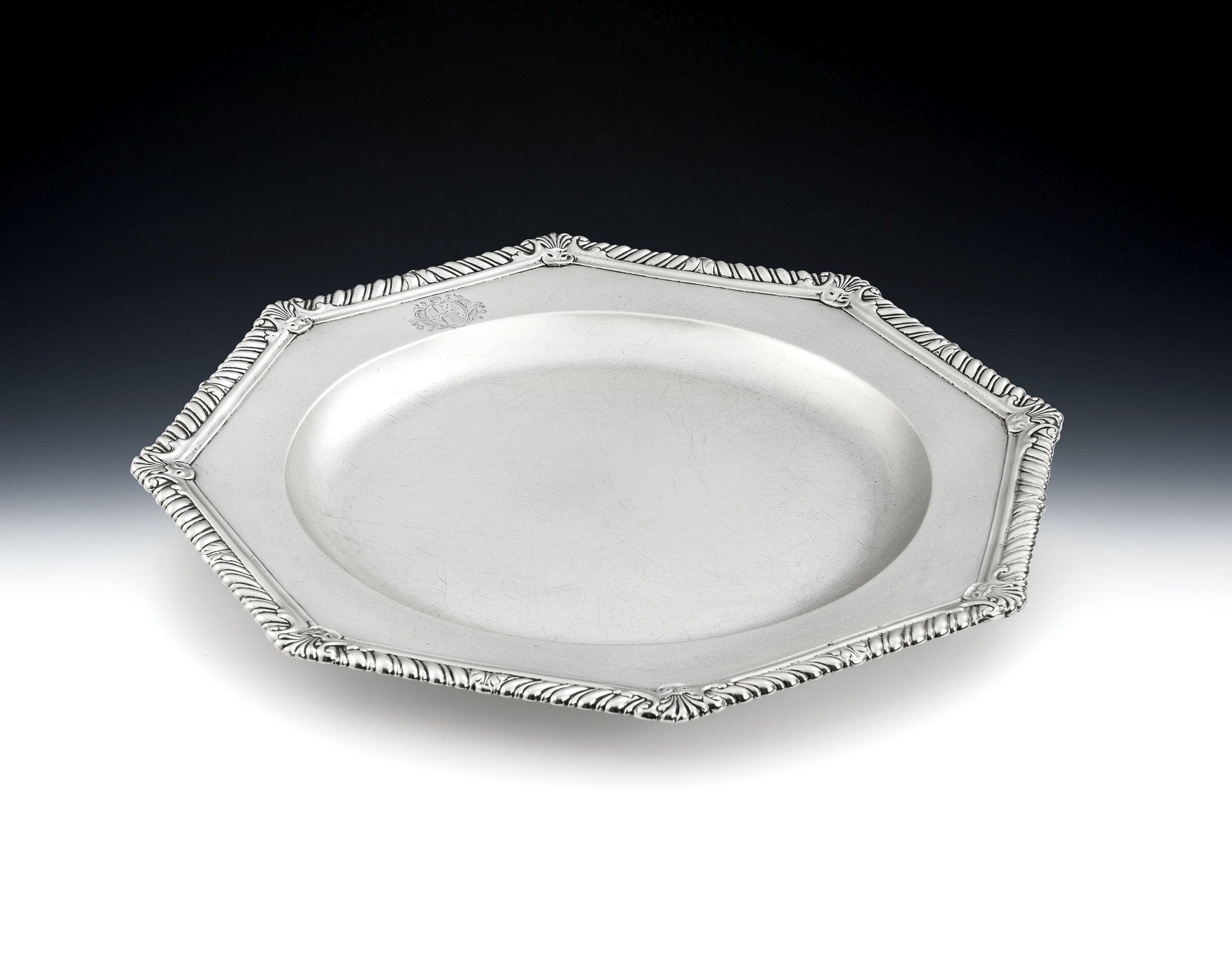
A very unusual George II Octagonal Serving/Sideboard Dish, of good size, made in London in 1759 by William Cripps.
A very unusual George II Octagonal Serving/Sideboard Dish, of good size, made in London in 1759 by William Cripps.
375606
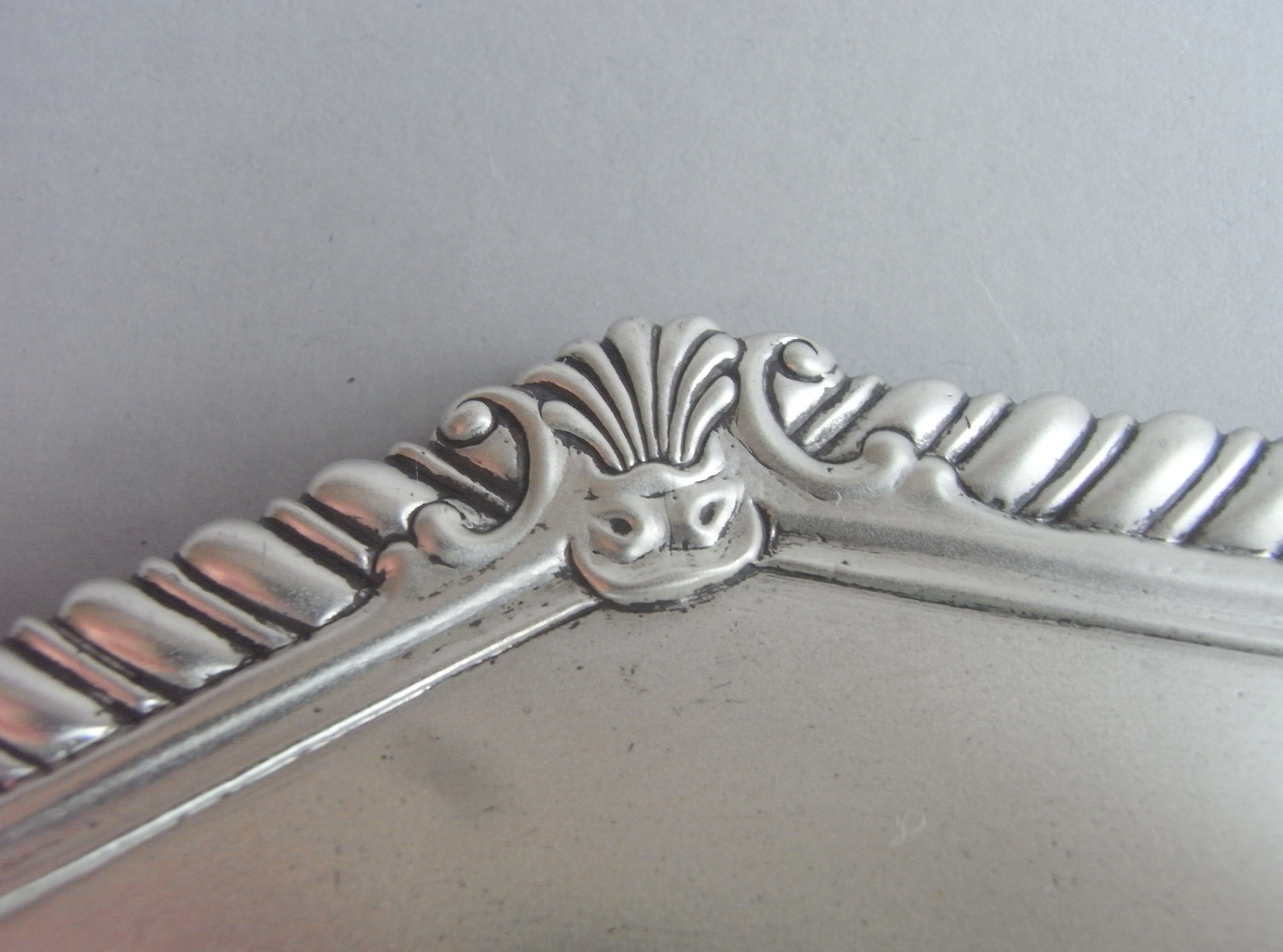
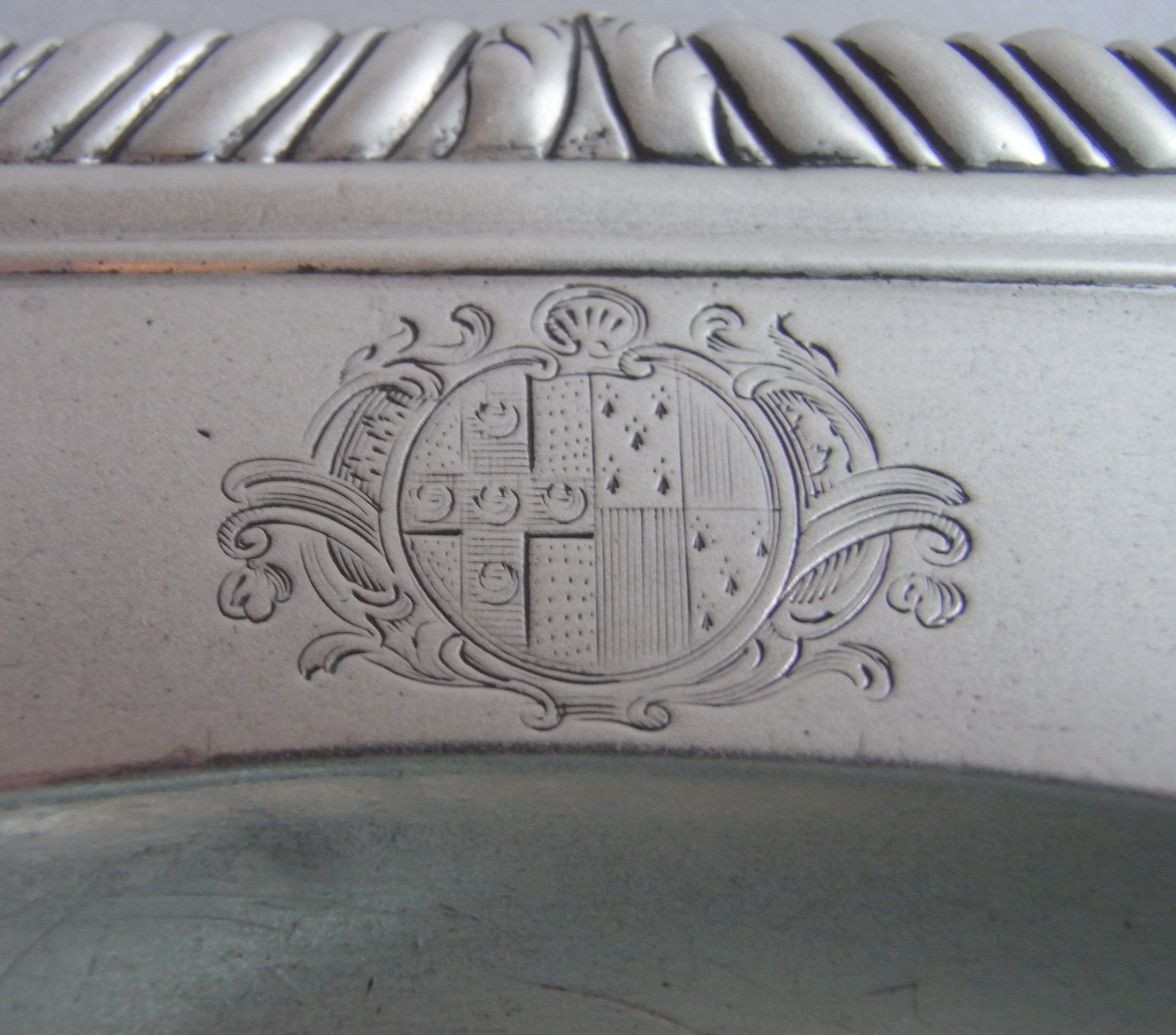
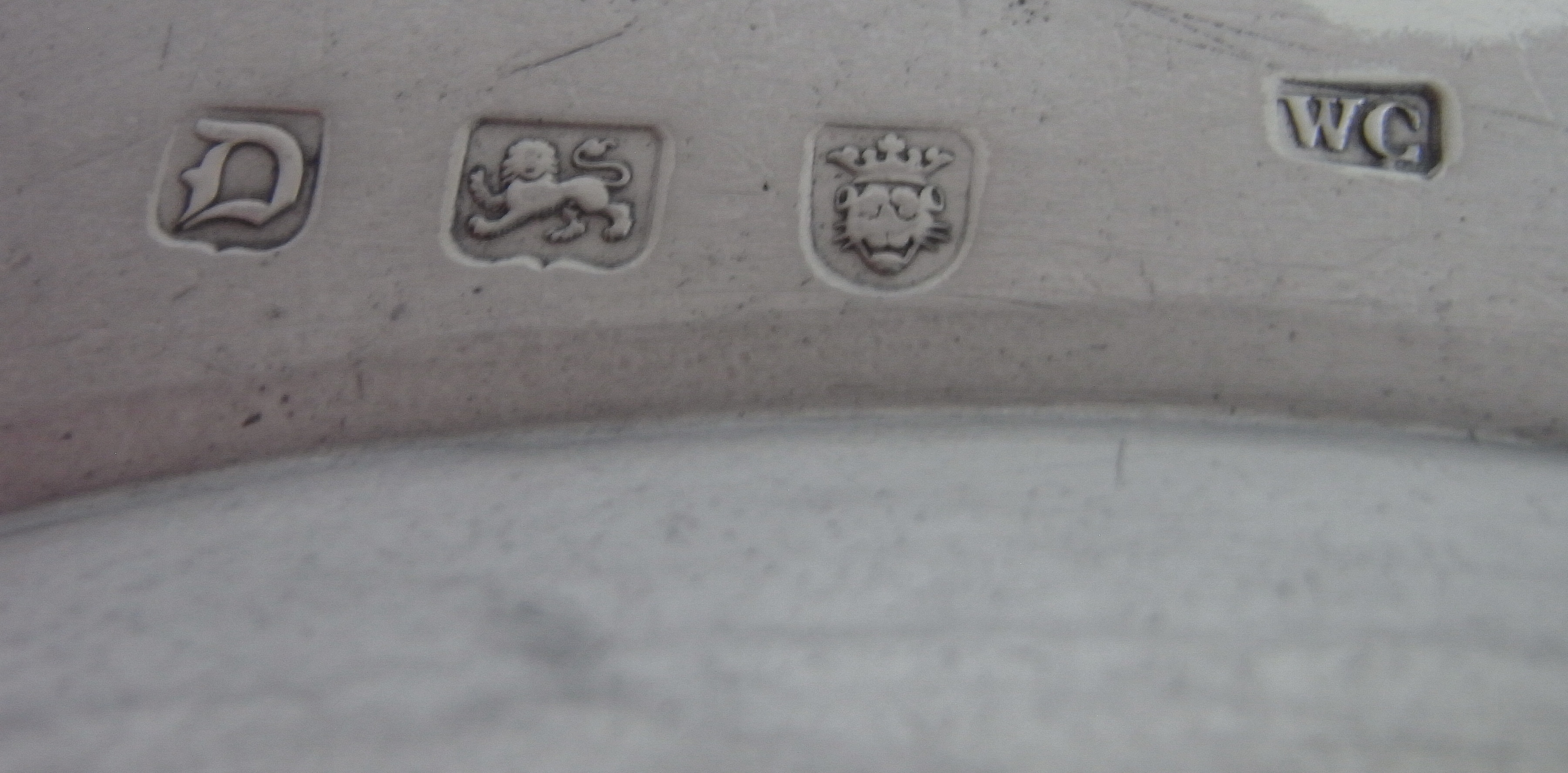
The Dish is modelled in a very unusual octagonal form with raised border decorated with gold gadrooning interspersed with leaf capping and anthemions flanked by scrolls. The border is also engraved with a contemporary Armorial surrounded by a scroll, shell and strapwork cartouche. The Dish is in excellent condition, of a very good weight and fine colour. This piece displays a crisp set of marks on the reverse. Octagonal dishes are exceptionally as very few were produced during the Georgian period.
The arms are those of Bellamy impaling Stanhope specifically for Humphrey Bellamy the elder (died 1767). He was the son of Sir Edward Bellamy (d. 1749) who was knighted in 1727 and was Lord Mayor of London in 1734-1735. Bellamy was a member of the Fishmongers Company- he was also a Director and subsequently Governor of the Bank of England. This suggests a substantial mercantile fortune. In 1791 an attempt was made to rob Mr. and Mrs. Bellamy of Ewall, in Surrey. This seems to be Captain Humphrey Bellamy who had served in 2nd Horse Guards (The Blues). He was the grandson of Sir Edward Bellamy and only child of Humphrey Bellamy, the elder. Following the death of his father the son took over the tenancy of Lea Hall, Walthamstow. In 1790 Bellamy sold Lea Hall to William Northage and subsequently took up residence in Ewell.
With regard to the maker, William Cripps, (1715-1766), he was an exceptional manufacturing and retail silversmith who rose to prominence in London’s West End during the 1740s and 1750s. He was trained in the workshops of David Willaume (1658-1741), a highly successful goldsmith and banker, of Huguenot descent. Of the latter’s other apprentices the names of the following are familiar to collectors of 18th Century English silver: his son, the younger David Willaume (1693-1761); Lewis Mettayer (d. 1740), Paul Tanqueray, Charles Hatfield (c. 1739/40), Aymé Vedeau (c. 1780/81), William Kidney (1702?-1756), and Thomas Pitts (whose Air Street, Piccadilly, workshops were acquired by the young Paul Storr in 1793).
Cripps gains his freedom in 1738 and entered his first mark as a largeworker on 31 August 1743 from his premises at the sign of the Crown and Golden Ball, Compton Street, Soho. His second mark was entered on 16 July 1746 upon moving to the Golden Ball, ‘on the terrace’ in St. James’s Street, where he continued the Willaumes’s business until his death on 1 January 1766:
‘Yesterday Evening died at his House in St. James’s-Street of a Fit of Apoplexy, Mr Crips [sic] a Gold and Silver-Smith of great Business. He was suddenly seized after Supper on Tuesday Night, and continued in great Agonies til he expired.’ (The Public Advertiser, London, 2 January, 1766, p. 2c)
‘On Thursday last the Surgeons opened the Head of the late Mr. Cripps, Goldsmith and Jeweller of St. James’s-Street, who died on Wednesday Evening; and we hear his sudden death was occasioned by the bursting of a Vein in his Head.’ (The Public Advertiser, London, 4 January 1766, p. 2c)
It appears from his will, proved on 6 January 1766, that Cripps had neither wife nor children and that his business was continued by George Coyte (a friend of the artist Thomas Gainsborough), retail silversmith, to be succeeded by Mark Cripps, who seems to have been a near contemporary relation of William, perhaps a cousin.
‘As might be expected from his training under Willaume,’ writes Arthur Grimwade, Cripps ‘became an accomplished craftsman and a versatile exponent of the rococo style; to judge from his surviving pieces he enjoyed a considerable clientele.’
Diameter: 13 inches, 32.5 cm.
Weight: 35 oz.
RELATED ITEMS






. He was the son of Sir Edward Bellamy (d. 1749) who was knighted in 1727 and was Lord Mayor of London in 1734-1735. Bellamy was a member of the Fishmongers Company- he was also a Director and subsequently Governor of the Bank of England. This suggests a substantial mercantile fortune. In 1791 an attempt was made to rob Mr. and Mrs. Bellamy of Ewall, in Surrey. This seems to be Captain Humphrey Bellamy who had served in 2nd Horse Guards (The Blues). He was the grandson of Sir Edward Bellamy and only child of Humphrey Bellamy, the elder. Following the death of his father the son took over the tenancy of Lea Hall, Walthamstow. In 1790 Bellamy sold Lea Hall to William Northage and subsequently took up residence in Ewell. With regard to the maker, William Cripps, (1715-1766), he was an exceptional manufacturing and retail silversmith who rose to prominence in London’s West End during the 1740s and 1750s. He was trained in the workshops of David Willaume (1658-1741), a highly successful goldsmith and banker, of Huguenot descent. Of the latter’s other apprentices the names of the following are familiar to collectors of 18th Century English silver: his son, the younger David Willaume (1693-1761); Lewis Mettayer (d. 1740), Paul Tanqueray, Charles Hatfield (c. 1739/40), Aymé Vedeau (c. 1780/81), William Kidney (1702?-1756), and Thomas Pitts (whose Air Street, Piccadilly, workshops were acquired by the young Paul Storr in 1793).Cripps gains his freedom in 1738 and entered his first mark as a largeworker on 31 August 1743 from his premises at the sign of the Crown and Golden Ball, Compton Street, Soho. His second mark was entered on 16 July 1746 upon moving to the Golden Ball, ‘on the terrace’ in St. James’s Street, where he continued the Willaumes’s business until his death on 1 January 1766:‘Yesterday Evening died at his House in St. James’s-Street of a Fit of Apoplexy, Mr Crips [sic] a Gold and Silver-Smith of great Business. He was suddenly seized after Supper on Tuesday Night, and continued in great Agonies til he expired.’ (The Public Advertiser, London, 2 January, 1766, p. 2c)‘On Thursday last the Surgeons opened the Head of the late Mr. Cripps, Goldsmith and Jeweller of St. James’s-Street, who died on Wednesday Evening; and we hear his sudden death was occasioned by the bursting of a Vein in his Head.’ (The Public Advertiser, London, 4 January 1766, p. 2c)It appears from his will, proved on 6 January 1766, that Cripps had neither wife nor children and that his business was continued by George Coyte (a friend of the artist Thomas Gainsborough), retail silversmith, to be succeeded by Mark Cripps, who seems to have been a near contemporary relation of William, perhaps a cousin.‘As might be expected from his training under Willaume,’ writes Arthur Grimwade, Cripps ‘became an accomplished craftsman and a versatile exponent of the rococo style; to judge from his surviving pieces he enjoyed a considerable clientele.’Diameter: 13 inches, 32.5 cm.Weight: 35 oz. )